
Airplane-Gingerale Problems
AKA the time endometriosis had me praying over my blood-stained business pants because all I had packed was a carry-on

Read the connected poem for this story here, or wait for the reminder at the end.
Note: This essay was written for a course called Decolonial Feminisms. For me, recounting these events is an act of radical decolonial feminism itself. This story feels very personal to me, and I disagree with that feeling; I don’t think it is or should be personal, and that the feeling of wanting to keep it close to me is unearned shame.
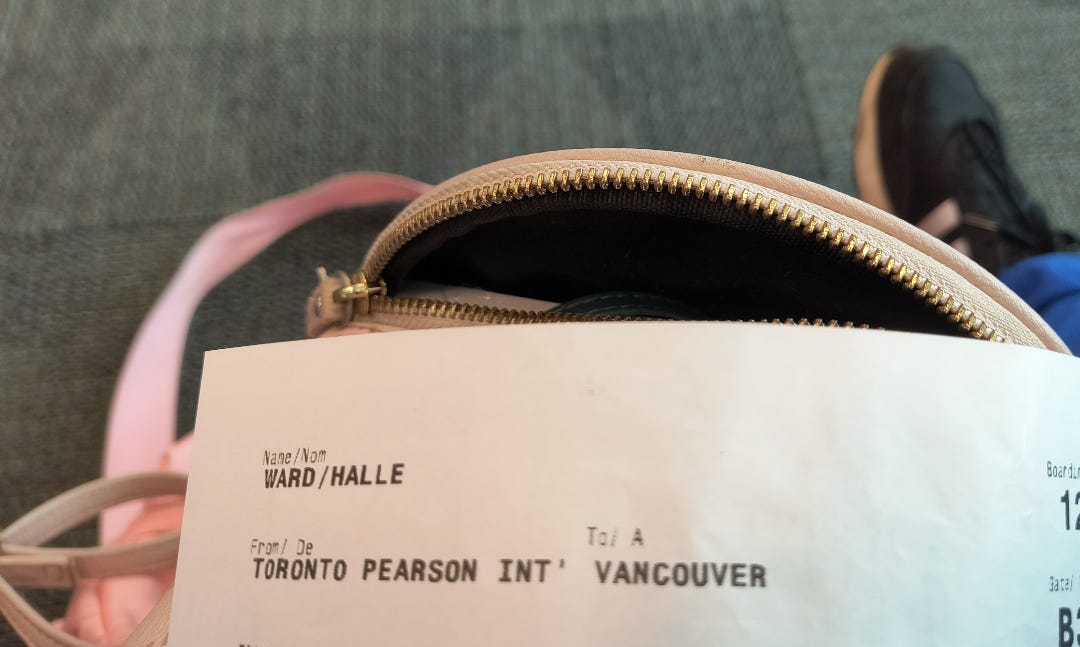
Since I’ve been working in the 2025 Audible Indigenous Writers’ Circle this year, in November I was attending the one and only in-person event hosted by the mentorship program. It was my first cross-country solo trip as it was hosted in Vancouver, and only my second ever flight.
Something that colonial bodies would have me believe to be a solely personal experience happened to me on this trip, that really brought out themes of decolonial feminism for me. About midway through the flight, I felt the telltale hot flashes; the ones that tell me I need to go find a safe place immediately. Problem: I was thirty thousand feet in the air and as alone as I’ve ever felt packed in with a hundred other people. You see, I have a “mystery” menstrual disorder that puts my body into labor when I get my period: hot flashes, nausea, contractions, searing pain, cold sweats, tunnel vision.
Now I was not only facing the grief of failed conception alone, so far away from my partner, but I was experiencing a degree of pain that I struggle to explain to people because I appear totally fine as soon as the next day. I noticed how invisible I felt from the moment it started. I was in tears, doubled over for the final two hours of the flight, and no one checked on me.
When the pain became unbearable, I hit the call button frantically and repeatedly and had to wait ten minutes for help by the presumably annoyed flight attendants. I was offered sympathy and help from everyone that I asked, until I clarified that the pain was being caused by my period. Suddenly, each time, their reaction would do a complete 180°, and this was from other women. Women who have had, or who have known others who have had, this very same pain.
It can be so powerful that I cannot walk standing up straight due to how contracted the muscles are in my pelvis and thighs. I was in enough pain to not even care about the small-pizza-sized blood stain on the back of my pants as I struggled to walk out. I was escorted off the plane in one of those airport golf carts. When I explained to the woman assisting what the problem was and asked if there was anywhere I could go lie down and call my husband, she became visibly uncomfortable and told me there was nothing else she could do for me and I’d have to walk myself to a cab. It might be the most vulnerable I have ever felt.
This pain, despite being a disorder and not typical menstrual pain, at least had space to exist in a time before our Euro-centric patriarchy. Even if not fully understood, women had the option to sit that time out and care for themselves, and even be cared for. “For instance, Ojibwe women traditionally secluded themselves in a moon lodge during menstruation. Women retreated to a small wigwam, where they slept separated from their husbands and infants. They refrained from sex, food preparation, and ceremony. They were careful not to step over young children, touch babies, men, or communal food. Female friends and relatives ensured the menstruating woman was safe and fed, and they helped care for her family in her absence” (Pember 2019).
On this trip, I learned how much I am capable of, and how I wish I didn’t have to be capable of it. I learned because of this episode that my grandmother and five of her sisters had to have hysterectomies for their endometriosis pain. I mourned them and all of the other women that have to push through this pain every month because we live in a society that no longer reveres the menstrual cycle, and instead has made it so taboo that support is considered only in the rarest, most extraordinary cases, despite at least 10% of people with uteruses suffering endometriosis. My own disability cannot be accommodated because 1) it is sporadic, 2) it affects predominantly women, 3) it is considered ‘‘normal’’ and ‘‘natural’’, and 4) it will not be diagnosed until myself AND a doctor agree to an invasive surgery.
It often feels as though my life is at the whim of my uterus. I was put in the position of having to ignore my needs for comfort and safety to engage in an experience that most other participants didn’t have to think twice about. I was forced to cast aside my shame and ask for community. I begged for it. Some compassionate older women on the plane offered comfort and their own pain relievers. Some queer kin offered a listening ear, and some similar experiences. But others walked on by, embarrassed of the scene I was causing or indifferent towards the situation altogether.
This experience makes me curious about a future where we recenter the lunar calendar and flow through the cycle of the moon as was always done before. How would our day-to-day lives look different? How would expectations be managed differently? What would “productivity” truly look like, especially for women? How would medicine change? What would happen to our relationships with our bodies? What would happen to men’s relationships to us?
♡ Hal
Once again, read my connected poem for this article here.
Work Cited:
Pember, Mary Annette. ““Honoring Our Monthly Moons”: Some Menstruation Rituals Give Indigenous Women Hope.” Rewire News Group, 20 Feb. 2019, rewirenewsgroup.com/2019/02/20/monthly-moons-menstruation-rituals-indigenous-women/.